
SatBase
World's largest spacecraft marketplace and early spacecraft formulation tools
Popular searches: Reaction wheels · Star trackers · X-band radios · Solar panels
Featured products
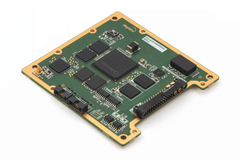
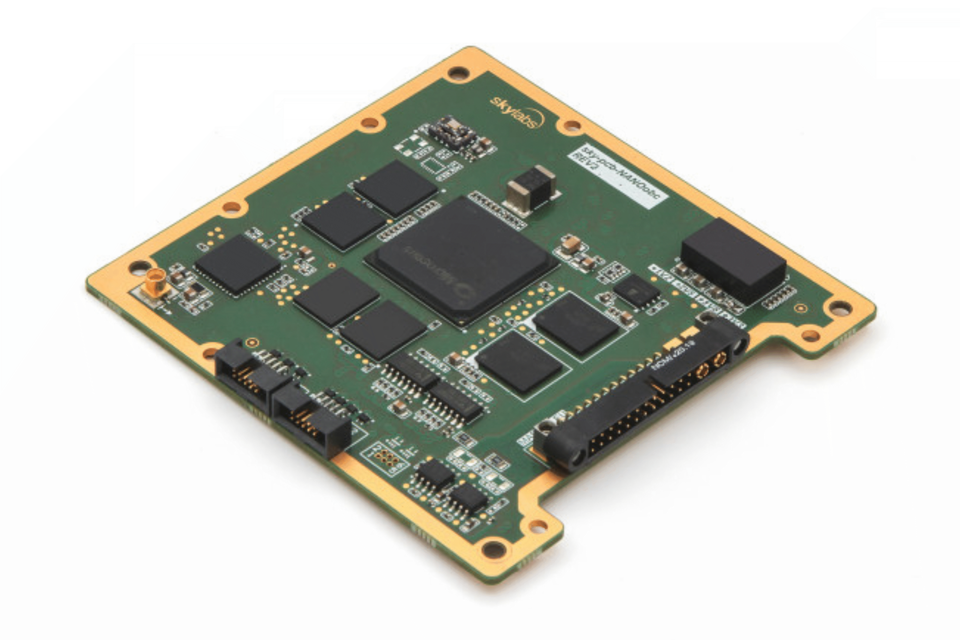
NANOobc-2 – OBC with CMM™ OBSW
The NANOobc-2 on-board computer represents the second generation of SkyLabs's flight proven OBC for the emerging space market. Its fault tolerance by design provides remarkable reliability and robustness against SEE. The NANOobc-2 is powered by PicoSkyFT processor, which furthermore increases operational reliability and delivers nearly 16 MIPS. NANOobc-2 features a redundant mass storage and sufficient capacity of non-volatile and volatile program and data memories to assure functionality for the most demanding space applications. The fault tolerance of the system by design offers higher reliability and robustness against Single Event Effects (SEE). The flight proven NANOsky CMM Firmware framework can be optionally added to the system on which mission specific application layer functions can be developed.
KEY FEATURES
Fault Tolerant PicoSkyFT processor @ 16 MHz
PicoSkyFT-L 8/16-bit architecture
Single precision FPU (optional)
2 MB MRAM for program memory
1 MB SRAM for data memory
4 Mbit NMV for TM storage (unlimited read/write endurance)
Redundant 2Gb NAND Flash for mass storage
Redundant CAN-TS for TM/TC
2x High-speed LVDS or RS422/485 channels
8x GPIO (with multifunction support UART/SPI/TWI and OBT trigger)
GNSS receiver on board (GPS / GLONASS / Galileo / BDS / QZSS )
Compatible with the PC-104 form factor.
SK
SkyLabs 
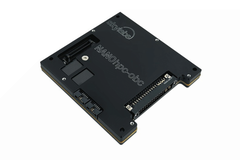
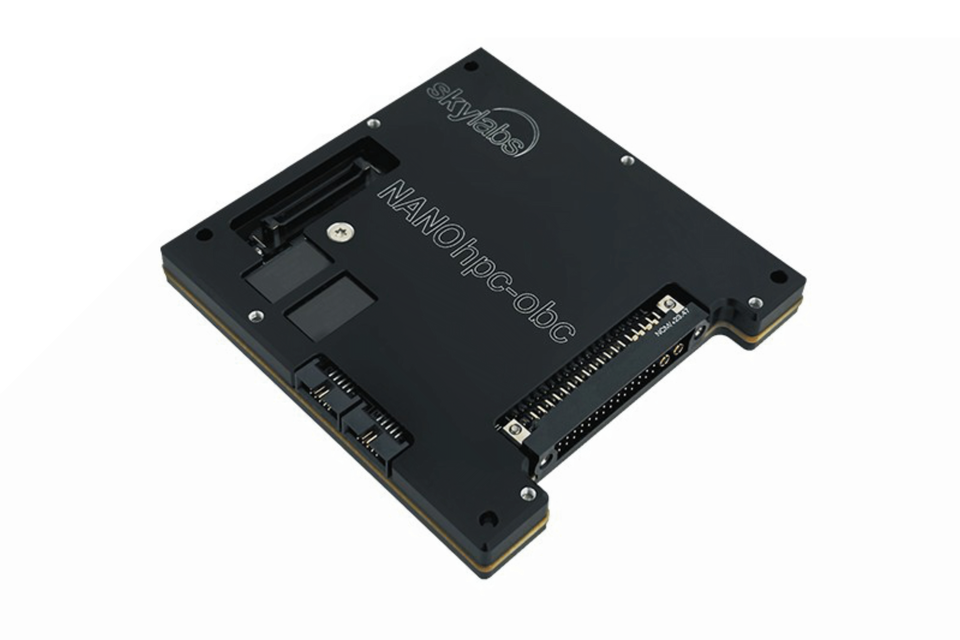
NANOhpc-obc - High performance fault-tolerant OBC
The NANOhpc-obc is a 64-bit high-performance multicore RISC-V on-board computer specifically designed for demanding LEO applications that require exceptional performance. It targets key market opportunities, including AI@Edge, situational awareness, and cybersecurity.
With a best-in-class performance-to-power ratio, the NANOhpc-obc delivers over 4000 DMIPS at 600 MHz across 4 RISC-V cores, consuming 3 W. This product pushes on-board intelligence to its limits, addressing the most challenging computational needs.
Equipped with a rich set of embedded peripherals and a coherent multicore cluster, the NANOhpc-obc supports a versatile mix of deterministic real-time systems and Linux, making it ideally suited for power-efficient embedded computing across a wide range of applications.
Expansion boards enable extra processing power in the form of AI co-processor or digital processing unit (DPU).
KEY FEATURES
Main CPU cluster: 4x RISC-V 64-bit processors @ max 600 MHz
Matrix Coprocessor: Single/Multi Arithmetic Accelerator for elementwise Tensor operations
Supervisor: RISC-V monitoring core @ max 600 MHz
Memory subsystem: 64kB L1 and 2MB L2 memory (SECDED protected) MMU with Physical memory protection
Main memory: 2 GB LPDDR4
Mass storage: 92 GB NAND (EDAC protected)
TM storage: 256 kB MRAM with SECDED
Interfaces: Redundant CAN, 4x LVDS/RS422/485/UART/16xGPIO, 2x Gigabit ETH
Extension interface: PCIe Gen2 X4/X2 Root Port, SMBus, GPIOs
Software: Linux (Yocto, BuildRoot),
SK
SkyLabs 
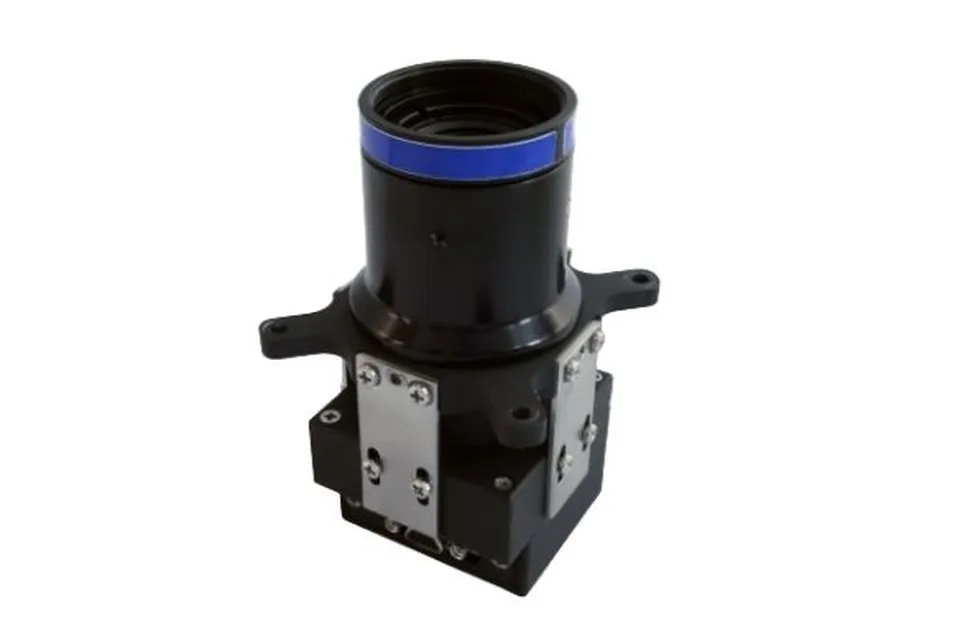
ST-400
The ST400 is the bigger brother of the successful ST200 star tracker. It uses the same proven electronics but uses a different opto-mechanics. The ST400 trades an increased resolution for being a little larger than the miniature ST200. Like ST200, the ST400 has been developed in cooperation with Hyperion Technologies B.V. The ST400 delivers a full and autonomous attitude solution and is your attitude sensing solution for missions with demanding accuracy requirements.
Characteristics:
Accuracy: 5 arcsec (RMS)
Tracking Update: 5 Hz
Limiting Magnitude: 6.0
Data Interfaces: RS422
Supply Voltage: 3.7-5.0 V
Power Consumption: 670 mW @3.7 V
Operating Temperature: -20°C to +40°C
Dimension (w/o Baffle): 48 x 57 x 91 mm³
Dimension (w/ 40° Baffle): 74 x 74 x 146 mm³
Mass (w/o Baffle): 250 g
Mass (40° Baffle): 350 g
Design Life: 5 years LEO
Space Heritage: Yes
Radiation Test: 11 krad (Proton 130 MeV source)
Available files
BE
Berlin Space Technologies 
Product Suite
What SatBase offers
Clear paths for the two primary audiences: engineers looking for parts and suppliers listing products.
SatBase API
Access the data
Coming Soon
Search SatCatalog
Search for components, suppliers, flight proven components, and more...
Top Categories
Subcategories
Attitude Determination & Control System
Command & Data Handling System
Communication System
Onboard Software (FSW)
Power System
Propulsion System
Structure & Mechanism
Thermal System

How SatBase works
For engineers
1
Search and filter
Filter by mass, power, heritage, etc... to narrow down solutions.
2
Compare options
Side-by-side specs; save shortlists for team review.
3
Send inquiry
Contact suppliers for quotes and general information.
Reply time
24 hrs
Spec filters
20+
Products available
1,000+
For suppliers
1
Create profile & list products
Get your products listed within as little as 15 minutes.
2
Receive leads
Receive inquiries from potential customers
3
Convert & track
Convert inquiries into sales and grow your business
Increase in sales
+27%
Placement
Premium
Badge
Verified
Join Our Global Supplier Program
Get discovered in spec-driven searches, receive qualified inquiries, and track conversions with simple analytics.
- +27% increase in inquiries
- Verified supplier badge
- Inquiry routing & alerts
- Analytics dashboard
"We doubled the amount of inquiries, leading to more sales." — OrbitComms
What you'll need
- 1. Company profile (logo, description, contacts)
- 2. Product listings (spec tables, images, variants)
- 3. Lead routing email(s) and response SLA
Onboarding
~15 min
Avg time to publish
<24 h
Cost
Freemium
Popular tools
Simple and easy to use tools for space-related calculations.
Propellant Mass Calculator
Compute exhaust velocity, propellant mass, and final mass with rocketry equations.
Outputs
Exhaust velocity
180 m/s
Propellant mass
75 kg
Final mass
105 kg
447 calculations today